“Advancing Innovation in Oncology: Hanmi Showcases Next Generation Drug Innovations at AACR”
“Advancing Innovation in Oncology: Hanmi Showcases Next-Generation Drug Innovations at AACR”
Hanmi to unveil 9 preclinical studies across 8 new drug candidates
Highlighting oncology technology competitiveness built on emerging modalities such as next-gen mRNA, TPD, and ADCs
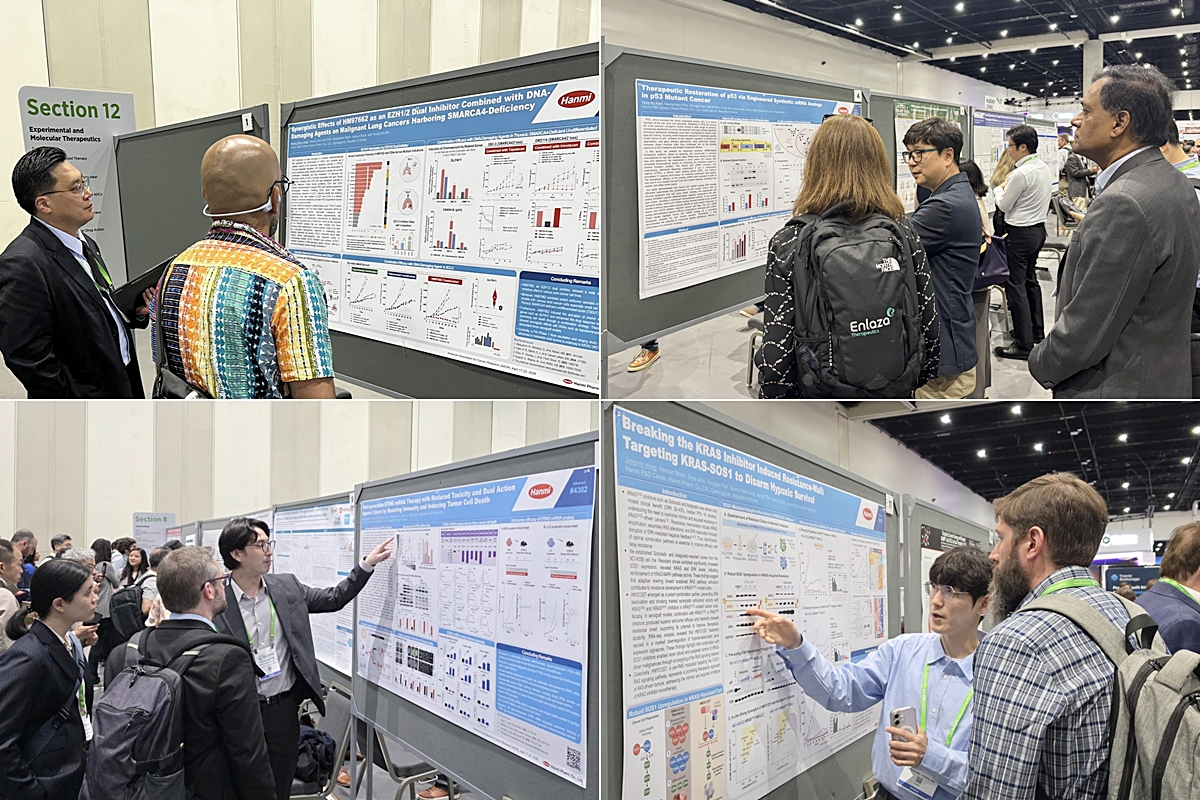
Researchers from Hanmi’s R&D Center explain poster presentations featuring innovative oncology drug research results to attendees at AACR 2026, held in San Diego, USA, from April 17 to 22 (local time).
(April 28, 2026) Hanmi drew strong interest from the global biopharma community by unveiling a broad oncology new drug pipeline backed by extensive technological capabilities that integrate next-generation modalities.
The company continues to secure future growth engines by deriving multiple new programs using a diverse range of approaches―messenger ribonucleic acid (mRNA), Targeted Protein Degradation (TPD), antibody-drug conjugates (ADCs), and bispecific antibodies―now emerging as core technologies in the global oncology market.
Hanmi Pharmaceutical announced on April 28, that it presented nine research outcomes across eight new drug candidates at AACR 2026, held in San Diego, USA, from April 17 to 22.
For the fourth consecutive year, Hanmi delivered the highest number of research presentations among Korean pharmaceutical and biotechnology companies―an achievement widely seen as further proof that Hanmi is leading new drug development using diverse modalities capable of reshaping the cancer treatment paradigm, grounded in its accumulated R&D capabilities in oncology.
At this year’s conference, Hanmi presented its oncology pipeline, broadly categorized into three areas: ▲selective targeted anticancer therapies focused on proteins highly expressed in cancer cells ▲next?generation modality?based targeted anticancer agents, and ▲next?generation modality?based immuno?oncology therapies designed to activate immune cells and drive antitumor responses.
In the targeted oncology space, Hanmi presented research findings on several novel drug candidates demonstrating mechanistic differentiation across diverse targets, including an ▲EZH1/2 dual inhibitor (HM97662) ▲a selective HER2 inhibitor (HM100714) ▲and an inhibitor targeting the SOS1?KRAS interaction (HM101207).
HM97662 is being developed as a next-generation, innovative targeted therapy with a “dual inhibition mechanism” that simultaneously inhibits EZH1 and EZH2 proteins―offering superior antitumor efficacy and the potential to overcome resistance compared with EZH2-selective inhibitors.
At the meeting, Hanmi presented findings showing antitumor synergy when HM97662 was combined with a DNA-damaging agent in solid tumor animal models harboring specific genetic alterations such as SMARCA4 deficiency. Notably, repeated combination dosing of HM97662 with a DNA-damaging agent suggested potential to overcome resistance to existing therapies; based on these results, Hanmi plans to refine target indications and pursue expansion into follow-on combination clinical trials.
HM100714 demonstrated robust antitumor efficacy in HER2-mutant cancers along with low EGFR (epidermal growth factor receptor)-related toxicity, confirming antitumor activity in an Enhertu-resistant xenograft mouse model; it also showed strong efficacy and a favorable safety profile in brain and leptomeningeal metastasis models. Using bioinformatics and machine learning?based analyses, Hanmi predicted drug sensitivity across a 75-cell-line panel and derived optimal indications―thereby establishing the rationale for clinical development as an oral new drug.
HM101207, a SOS1?KRAS interaction inhibitor, is a novel-mechanism candidate designed to suppress activation of KRAS―one of the most critical oncogenic driver mutations―by blocking binding between SOS1 and KRAS, key regulators in the signaling cascade. At AACR 2026, Hanmi presented data suggesting therapeutic potential in KRAS-dependent cancers by modulating hypoxia-related gene expression in addition to KRAS signaling suppression.
In particular, HM101207 showed synergistic antitumor effects in KRAS G12C?mutant cancer cell lines when combined with various RAS/MAPK pathway inhibitors. In KRAS-mutant xenograft models, combination treatment with a KRAS G12C inhibitor or a RAS inhibitor significantly delayed emergence of resistance compared with monotherapy.
In the next-generation modality?based targeted oncology category, Hanmi presented research findings on an ▲oral EP300 selective degrader developed by applying its proprietary targeted protein degradation (TPD) platform technology.
Hanmi researchers optimized the compound through structure design based on molecular dynamics simulation data, and used a bioinformatics framework and machine learning models to identify solid tumor indications most sensitive to EP300 degradation.
At the meeting, Hanmi unveiled results showing superior antitumor efficacy with lower toxicity versus EP300/CBP dual inhibitors in xenograft solid tumor models, and presented evidence supporting a “synthetic lethality” mechanism.
In the field of next-generation modality?based immuno-oncology, Hanmi highlighted research achievements across its pipeline, including the ▲STING mRNA anticancer candidate and ▲p53 mRNA anticancer candidate, as well as next-generation multispecific antibody programs such as the ▲4-1BB x PD-L1 bispecific antibody (BH3120) and the ▲B7H3 x PD-L1 bispecific antibody?drug conjugate (ADC, BH4601), both of which are being developed under the leadership of Beijing Hanmi Pharmaceutical.
The STING mRNA anticancer candidate is designed to directly activate the STING (Stimulator of IFN Genes) pathway without ligand binding to trigger antitumor immune responses, and is differentiated by its design enabling systemic administration.
Hanmi confirmed meaningful tumor growth inhibition following intravenous and intramuscular administration in animal models, and demonstrated immune-cell infiltration and antitumor efficacy even in “immune-cold” tumors that do not respond to existing immunotherapies. In particular, the company elucidated a “dual mechanism” that directly suppresses cancer cell proliferation while maintaining survival capacity in normal cells, alongside immune activation.
The p53 mRNA anticancer candidate is designed to induce cancer cell apoptosis by restoring normal intracellular expression of the tumor suppressor protein p53, and two studies were disclosed at this conference.
Hanmi confirmed that the candidate showed superior antitumor efficacy versus existing agents and a favorable safety profile in an ovarian cancer animal model, and proposed a strategy to predict responsiveness to p53 restoration therapy in advance and identify cancer types with high applicability through transcriptome-based analyses. This suggested the potential to expand precision application of p53 restoration therapy and broaden combination strategies with DNA damage?based anticancer agents.
BH3120 is an oncology candidate built on the bispecific antibody platform “Pentambody,” enabling both targeted anticancer effects focused on tumor cells and immuno-oncology effects that activate immune cells.
At this conference, Beijing Hanmi disclosed mechanistic study results showing that, in combination with a CD3 T cell engager (TCE), the two mechanisms act complementarily to amplify antitumor effects. As a core immuno-oncology approach that directly activates T cells in the body, TCEs have recently gained visibility as next-generation oncology technologies amid increasing FDA approval cases.
BH4601 is a next-generation oncology project based on a bispecific ADC simultaneously targeting B7H3 and PD-L1. At the meeting, Beijing Hanmi presented a differentiated mechanism designed to broadly target both proteins expressed across diverse solid tumors, potentially reducing drug resistance versus conventional ADCs, inducing immune activation, and delivering enhanced antitumor activity.
“Through this year’s AACR 2026, we showcased our next-generation modality?focused oncology pipeline that leads global new drug development trends, widely communicating Hanmi’s evidence-based R&D competitiveness and receiving strong recognition for those capabilities,” said Dr. In Young Choi, Head of the R&D Center at Hanmi Pharmaceutical. “Going forward, we will continue to secure innovative growth engines through differentiated technology convergence and strategic R&D, while integrating new technologies across the full research continuum to further expand Hanmi’s future value.”