Hanmi Debuts Novel EP300 Degrader Showcasing its Next-Gen TPD Platform
Hanmi Debuts Novel EP300 Degrader Showcasing its Next-Gen TPD Platform
Hanmi Presents Five Anticancer Research Studies at AACR-NCI-EORTC 2025
Selective EP300 degrader induces targeted cell death through “synthetic lethality”
Novel mRNA-based STING and p53 cancer immunotherapies demonstrate potent antitumor efficacy
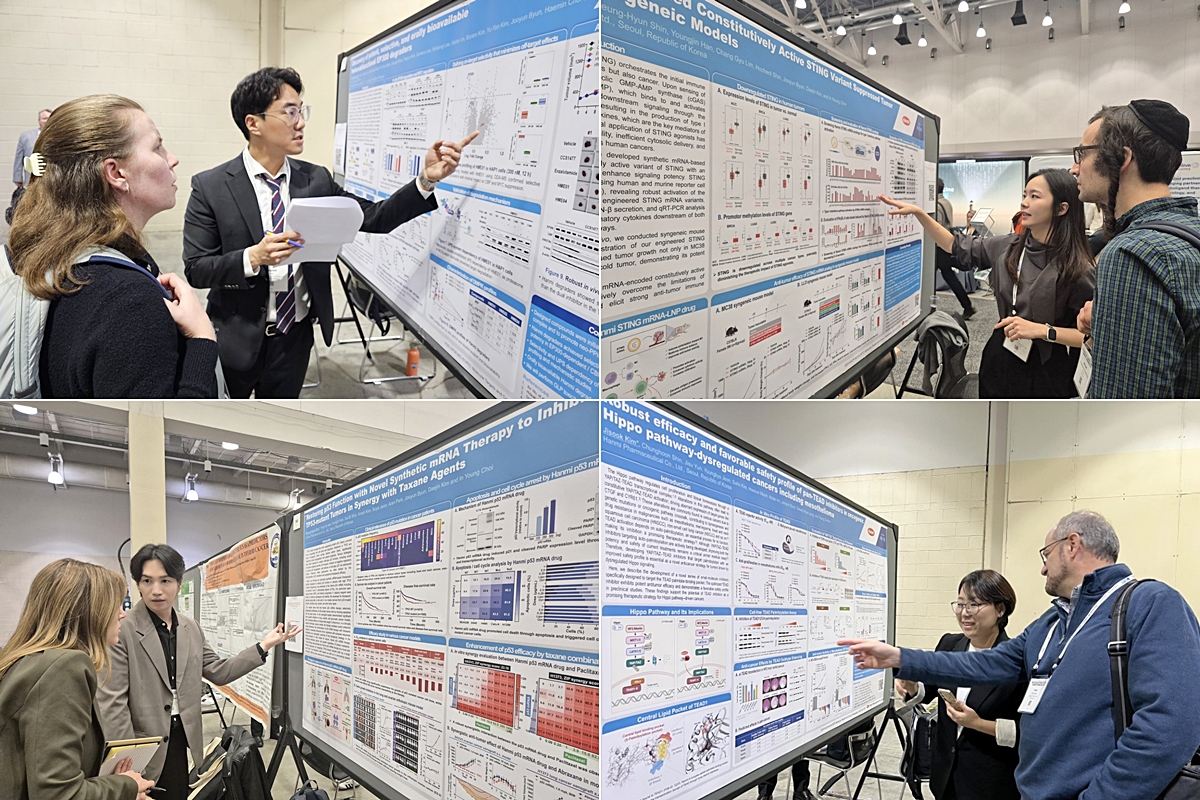
Researchers from Hanmi R&D Center explained their innovative anticancer drug research to atendees using posters displayed at the AACR-NCI-EORTC 2025 International Cancer Conference, held in Boston, USA, from October 22 to 26 (local time).
(Seoul, October 29, 2025) ― Hanmi Pharmaceutical, unveiled its new pipeline “Selective EP300 Degrader” for the first time at one of the world’s most prestigious oncology conferences, drawing significant attention for its novel and distinctive approach to drug discovery.
This achievement highlights Hanmi’s expansion into next-generation modalities that could redefine cancer treatment paradigms, while also strengthening its global competitiveness and securing new growth engines for the future.
At the AACR-NCI-EORTC 2025 conference held in Boston from October 22 to 26 (local time), Hanmi presented five preclinical research posters, covering:
▲Discovery of potent, selective, and orally bioavailable heterobifunctional EP300 degraders
▲SOS1-panKRAS modulator, HM101207: A top candidate to control KRAS-MAPK-driven cancers through strong synergy with vertical inhibitors
▲Robust efficacy and favorable safety profile of pan-TEAD inhibitors in oncogenic Hippo pathway-dysregulated cancers including mesothelioma
▲Novel mRNA-encoded constitutively active STING variant suppressed tumor growth in syngeneic models
▲Restoring p53 function with novel synthetic mRNA therapy to inhibit growth of TP53-mutant tumors in synergy with taxane agents
The Selective EP300 Degrader, which attracted particular interest, is an anticancer candidate developed using Hanmi’s novel Targeted Protein Degradation (TPD) platform. It selectively induces cell death in EP300-dependent or CBP-mutant cancer cells through a synthetic lethality mechanism.
EP300 and CBP proteins are transcriptional co-activators with histone acetyltransferase (HAT) activity, collectively referred to as “HAT co-activators.” In normal cells, they function in a complementary manner; however, CBP-mutant cancers are known to depend heavily on EP300. Due to the high structural similarity between the two proteins, developing a drug that selectively targets EP300 has long been a major challenge.
At the conference, Hanmi reported that its selective EP300 degrader demonstrated strong antitumor activity in both EP300-dependent and CBP-mutant cell lines. Furthermore, in prostate cancer xenograft models, it exhibited superior tumor inhibition compared with first-line therapies and dual EP300/CBP inhibitors.
These findings highlight the compound’s favorable metabolic stability and oral bioavailability, suggesting its potential as a novel therapeutic option for EP300-dependent and CBP-mutant cancers.
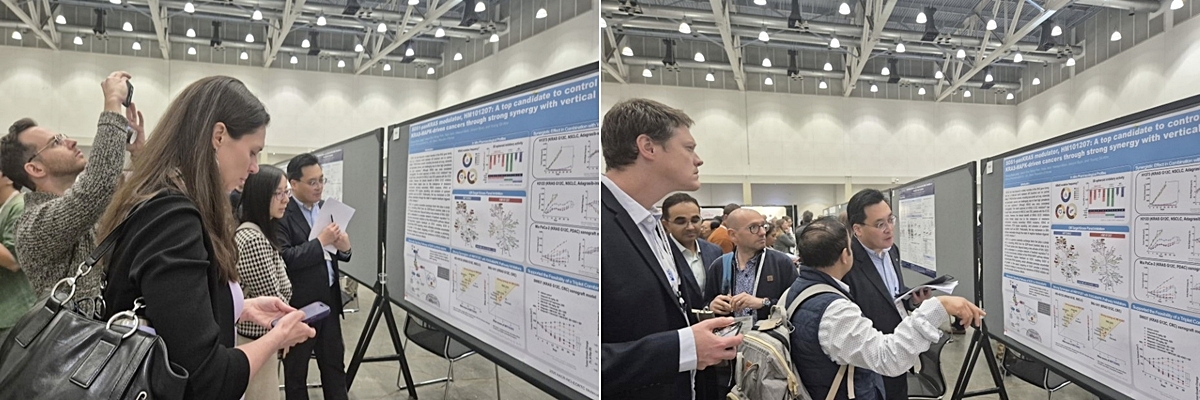
Dr. Seung Hyun Jung at Hanmi R&D Center explained the study on “SOS1-KRAS Interaction Inhibitor (HM101207)”, a promising candidate for global combination cancer therapy strategies, to attendees using a research poster.
In another presentation, Hanmi shared new results on its SOS1-KRAS interaction inhibitor (HM101207)―a promising candidate for combination therapy strategies against RAS-driven cancers. The data confirmed its superior antitumor efficacy compared with competing candidates.
HM101207 is a novel SOS1-panKRAS modulator designed to suppress the interaction between SOS1, a key regulator in the signaling cascade, and KRAS, thereby preventing the activation of KRAS mutations, one of the most frequently occurring oncogenic drivers across multiple cancer types.
By binding to multiple KRAS variants and supressing downstream signaling, HM101207 can effectively suppress tumor growth and potentially overcome resistance mechanisms that emerge from treatment with KRAS G12C inhibitors, RTK inhibitors, or MAPK pathway inhibitors.
HM101207 exhibited strong anticancer synergy when combined with various RAS-off inhibitors. With its high target selectivity and minimal drug-drug interaction (DDI) profile, HM101207 is considered a strong candidate for global combination therapy strategies in oncology.
Hanmi also presented significant progress in its mRNA platform-based immuno-oncology therapies, underscoring its potential to drive a paradigm shift in new drug development.
The STING mRNA anticancer candidate directly expresses the STING (Stimulator of IFN Genes) protein, inducing a powerful antitumor immune response. By fundamentally reprogramming the initiation of immune signaling, this therapy represents a “reboot” strategy for overcoming tumor immune evasion.
Conventional immunotherapies have primarily focused on restoring T-cell function through checkpoint inhibitors. However, conventional STING agonists have faced limitations, including metabolic instability, inefficient intracellular delivery, and reduced STING expression in tumors, resulting in limited clinical efficacy.
At the conference, Hanmi presented data showing that STING mRNA monotherapy produced significant tumor growth inhibition and favorable safety profiles in colorectal and lung cancer animal models. Given its compatibility with various combination regimens, the STING mRNA therapy is expected to deliver strong synergistic effects with other anticancer agents.
Hanmi also unveiled results from its p53 mRNA candidate, which induces apoptosis in cancer cells by restoring intracellular expression of the tumor suppressor protein p53. The study demonstrated enhanced antitumor activity in orthotopic animal models of lung and ovarian cancer.
In particular, the p53 mRNA therapy demonstrated excellent synergy with taxane-based chemotherapies, showing enhanced antitumor activity when combined with Abraxane in the same preclinical models.
Furthermore, the p53 mRNA-based anticancer drug demonstrated significant efficacy even in paclitaxel-resistant cell lines, suggesting its potential to overcome drug resistance.
Hanmi’s YAP/TAZ-TEAD inhibitor binds to the TEAD palmitate-binding pocket (PBP), a structural site critical for TEAD stability, thereby suppressing aberrant YAP/TAZ-TEAD signaling found in Hippo pathway-dysregulated cancers.
Hanmi’s YAP/TAZ-TEAD inhibitor exhibited potent tumor growth inhibition in Hippo pathway-mutant mesothelioma cell lines, accompanied by significant, dose-dependent reductions in YAP/TAZ-TEAD target gene expression.
In mesothelioma xenograft mouse models, Hanmi’s YAP/TAZ-TEAD inhibitor exhibited robust antitumor activity and sustained target gene suppression, while exhibiting improved renal safety over competitors, as indicated by reductions in proteinuria and nephrotoxicity biomarkers.
“Hanmi’s oncology pipeline, anchored by its TPD and mRNA platforms, is expanding into a broader range of next-generation modalities, including cell and gene therapies (CGT), antibody-drug conjugates (ADCs), and single-domain antibodies (sdAbs),” said Dr. In Young Choi, Executive Vice President and Head of the R&D Center at Hanmi Pharmaceutical.
“We will fully leverage the innovative potential of these emerging modalities to accelerate the development of globally competitive, first-in-class anticancer therapies,” he added.
■ Contact info:
Official Websites: www.hanmipharm.com
innovation@hanmi.co.kr, +82-410-0467